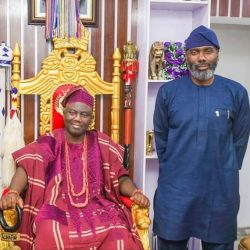
The Alaafin of Oyo, Oba Akeem Owoade, has revealed that 16 gold-plated beaded crowns were taken from the Alaafin’s palace during the British invasion of Oyo in November 1895. He described these crowns as deeply meaningful cultural, spiritual, and historical symbols for the Yoruba people.
The monarch shared this information while hosting the Director-General of the National Commission for Museums and Monuments (NCMM), Olugbile Holloway, at his Boroboro private residence in Oyo, Oyo State.
According to the Alaafin’s spokesperson, Bode Durojaiye, Holloway assured the palace that the commission is committed to recovering the stolen artifacts, just as it has worked toward retrieving the Benin artworks.
Oba Owoade emphasized that the crowns are not mere ornaments but important elements of Yoruba heritage.
“About 16 gold-plated beaded crowns were stolen during the raid on the palace in November 1895,” he said. “These artifacts represent cultural identity and carry spiritual and historical significance. Their return is vital to preserving our heritage.”
He also reflected on the legacy of the old Oyo Empire, describing it as a powerful political and military center known for its administrative brilliance and cultural influence. According to him, the empire’s sculptures, regalia, and other artifacts tell the story of its leadership, way of life, and historical transitions.
Oba Owoade further noted that many of these items were seized as trophies during British military campaigns in the 19th century, a period marked by colonial violence and the pursuit of trade dominance.
“The Alaafin is the guardian of these traditions,” he explained. “Bringing these objects home restores pride and strengthens our cultural identity. Their return is important for Nigeria’s development, especially through cultural tourism and community empowerment.”
Archbishop Emeritus Ayo Ladigbolu also spoke during the visit, offering more background on the 1895 invasion led by Captain Robert Bower, known as Ogun-Pepe. He stressed that the stolen artifacts are more than museum pieces.
“They are living cultural heritage,” he said. “They connect the Yoruba people to their origins and to the era of the Oyo Empire. Their loss is a historical injustice.”
He explained that many of these objects play essential roles in traditional ceremonies and festivals, such as the Sango and Oranmiyan celebrations. Removing them from their community strips them of their meaning, turning sacred objects into generic exhibits in Western museums.
Both the Alaafin and the NCMM expressed hope that the ongoing repatriation efforts will succeed, restoring a vital part of Yoruba history and identity.