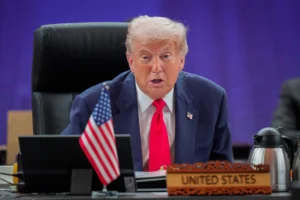
U.S. President Donald Trump has indicated that he would like the United States to have a say in determining who becomes Iran’s next supreme leader following the death of Ali Khamenei.
Speaking in an interview with Axios on Thursday, Trump dismissed the possibility of Khamenei’s son, Mojtaba Khamenei, succeeding his father. He described the idea as unacceptable and argued that Washington should play a role in shaping Iran’s future leadership to help maintain stability in the region.
Trump warned that if Iran ends up with a leader who continues the policies of the late Khamenei and is not acceptable to the United States, tensions could escalate again, potentially leading to another conflict within a few years.
During the interview, the U.S. president compared the situation in Iran to events in Venezuela, where he claimed Washington had influenced the leadership transition after the removal of Nicolás Maduro. He noted that the United States later worked with Delcy Rodríguez as the country’s interim leader.
Despite Trump’s comments, it remains uncertain how the United States could practically influence the choice of Iran’s next supreme leader. Under Iran’s political system, the position is determined by the Assembly of Experts, a body of senior Shiite clerics that traditionally operates independently of foreign influence and is largely opposed to U.S. involvement.
Khamenei, who had been Iran’s supreme leader since 1989, died last weekend after an Israeli strike during a period of escalating hostilities between Iran and Israel, with the United States also drawn into the conflict.
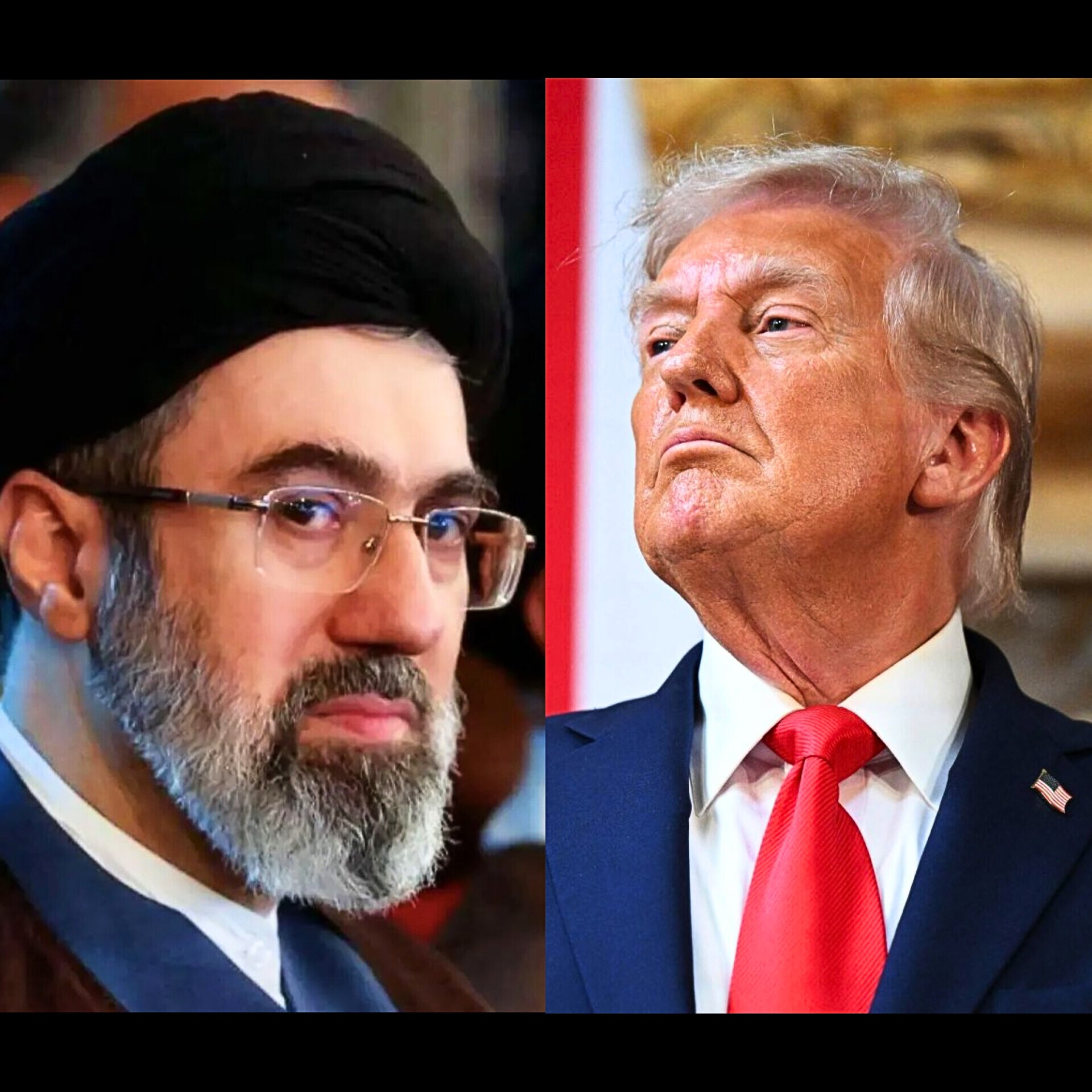
Since his death, speculation has intensified over who will take over the powerful position. Mojtaba Khamenei, known for his influence within Iran’s clerical and political circles, has emerged as one of the figures widely discussed as a potential successor.
At the same time, Reza Pahlavi, the son of Iran’s former monarch Mohammad Reza Pahlavi, has suggested he could temporarily assume leadership to oversee a political transition. Pahlavi argued that such an arrangement could allow Iran to draft a new constitution and eventually move toward a democratic form of government. He also maintained that any leader selected under the current Islamic Republic system would lack legitimacy.